"The little word 'is' has its tragedies; it marries and identifies different things with the greatest innocence; and yet no two are ever identical, and if therein lies the charm of wedding them and calling them one, therein too lies the danger. Whenever I use the word 'is,' except in sheer tautology, I deeply misuse it; and when I discover my error, the world seems to fall asunder and the members of my family no longer know one another." George Santayana, "Skepticism and Animal Faith," 1923.
"It depends on what the meaning of the word 'is' is." Bill Clinton, during his 1998 grand jury testimony on the Monica Lewinsky affair.
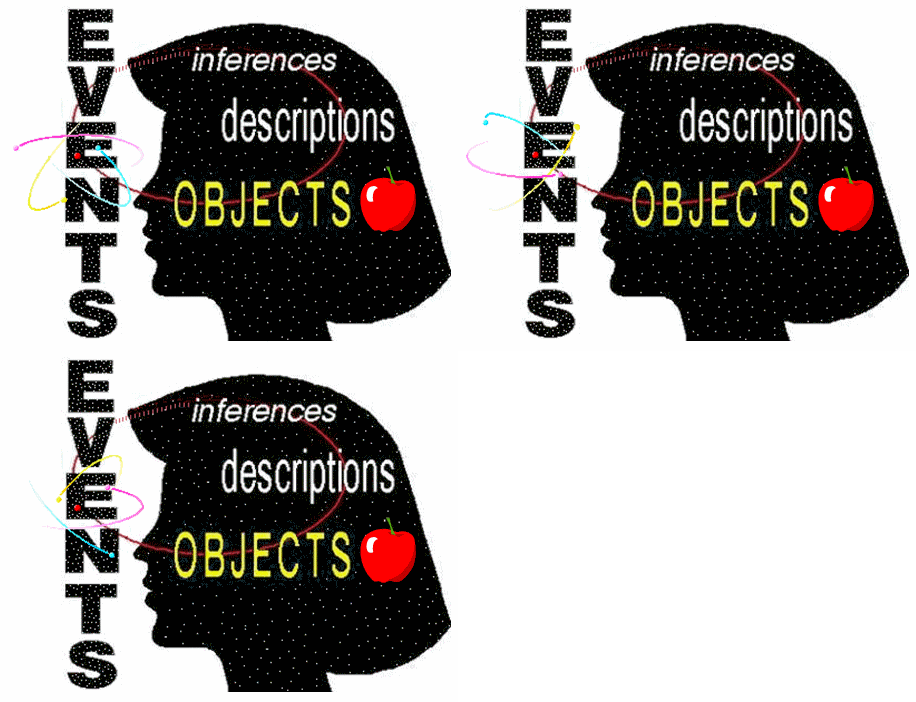
 Korzybski built his non-Aristotelian system on the rejection of the 'is of identity' or, in positive terms, on the principle of individuality ... that no two situations, individuals or stages of processes are the same in all details. The disregard of this principle, according to Korzybski, was the foundation of many misevaluations. His prescription for avoiding or treating the identity delusion was training in differentiation. In particular, Korzybski constructed a '3-dimensional' model (the structural differential) to help us visualize the difference between the different orders of abstraction. This meant training to differentiate individuals from generalities, words from their referents, descriptions from inferences, 'emotions' from the stimuli that evoked them ....

Korzybski noted that identity reactions can be promoted by the structure of languages. For example, the word "apple" does not differentiate among the different phenomena to which we routinely apply the label. Nor does "apple" differentiate among the various stages of development of any individual entity to which we may apply the label. And when we say, for example, "that apple is red" we may be confusing our response to the apple, "red," with the apple itself. In the dark, we would not see the apple as red; if we were wearing tinted glasses we may not see the apple as red; if we were 'color blind' we may not see the apple as red .... The structure of our statement, "that apple is red," may be both cause and effect of our misevaluation and may lead to unnecessary disagreements. A more structurally appropriate formulation would be "I see that apple as red." Here the observer is included in the statement, leaving open the option that other observers may abstract something different.

If we say "Milt is black" we may be evaluating Milt more on the basis of what he has in common with others ("black") and less on his individuality.
Korzybski cautioned against the thoughtless use of 'is' that implies identity, especially when applied directly to objective levels ... "this is a cup." He wrote: "... the use of the is of identity, as applied to objective, un-speakable levels, appears invariably structurally false to facts and must be entirely abandoned." (S&S p751)
As a result of Korzybski's warnings, movements such as E-Prime developed to try to purge forms of the verb "to be" from the English language. Curiously, though, Korzybski did not practice anything that remotely resembles E-Prime. He used "is" in its varied meanings throughout Science and Sanity and in his final paper written in 1950.
From the first edition of Science and Sanity (1933):
And from Korzybski's Introduction to the Second Edition of S&S (1941):
And from Korzybski's Preface to the Third Edition of S&S (1948):
And from Korzybski's final paper, written in 1950 and published after his death:
These quotations are representative of Korzybski's published writings and reflect Korzybski at different stages of his gs formulations. Clearly, Korzybski never found it necessary to avoid all uses of 'is' and its relatives despite his admonition that the "is of identity" must be "entirely abandoned." The apparent contradiction vanishes if one realizes that meanings are inside us and are not intrinsic to words. "Milton is writing" and "Milton is a Canadian" both contain "is" yet we evaluate these two "ises" differently because the contexts evoke different meanings. Labelling the second use of "is" as "is of identity" may be misleading because identity in the Korzybskian system refers to a confusion of two or more entities or stages of processes in our evaluations. The naked statement "Milton is a Canadian" does not give us evidence that the person making the statement is confusing Milton with any other Canadian. The naked statement does not tell us that we do not appreciate the individuality of Milton, only that we know something about Milt's origin or citizenship.
Because "identity" and "identification" have such specialized meanings within the Korzybskian system, I suggest we refer to uses of "is" as in "Milton is Canadian" as the "is of classification." This labelling is less inferential and more descriptive, and so does not induce us to jump to conclusions -- in other words, to "identify" or "confuse the orders of abstraction." If we assume that a person is identifying just because s/he uses the is of classification, we are pre-judging ... committing the same type of mistake we are supposedly trying to teach others to avoid. And we would have to condemn Korzybski for identifying every time he left statements that contain the so-called "is of identity" within Science and Sanity.
Before the 16th century the word hospital meant "guest house." The current meaning as a place to treat the sick did not evolve until later. Likewise, Korzybski's admonition against using the "is of identity" does not mean we must expunge from the language all forms of 'to be,' which is hardly practical. Instead, it points to the need to change the meanings-evaluations evoked in us so that the "is of identity" no longer means identity (sameness is all respects) but means merely classification (similar is some respects).
Expunging all forms of 'to be' from language would not eliminate the problems of identification. Living things identify, even if they have no language. Amoeba identify, Pavlov's dogs identified, human infants identify, people who are born into languages outside the Indo-European family identify. One's use of language may be a symptom of misevaluation on the semantic (non-verbal) levels. These misevaluations may be addressed in humans through the vehicle of language. However, the structure of language should not be confused with the non-verbal levels where the ultimate meanings-evaluations reside. We can, however, educate students to be conscious of abstracting, the sine qua non of training in Korzybskian general semantics. This includes a consciousness of the structural implications of our language .... E-prime can be a useful extensional training device in helping bring about this higher consciousness without, however, the necessity of 'banning' any forms of 'to be' from the language.